



IndyDevDan – Tactical Agentic Coding – Agentic Engineer + Principled AI Coding (Updated 2025) is an advanced AI engineering and agentic development program designed for developers who want to build intelligent AI systems capable of reasoning, planning, coding, and automating complex workflows.
As artificial intelligence rapidly transforms software development, this course focuses on one major shift:
moving from traditional programming to building AI-powered agentic systems that can think, act, and collaborate autonomously.
Rather than teaching basic prompt engineering or surface-level AI usage, the program focuses on production-ready AI engineering principles, autonomous workflows, tool integration, and scalable agent architectures.
Built by IndyDevDan, the course combines modern AI tooling, principled software engineering, structured reasoning systems, and practical implementation strategies to help developers build real-world AI-powered applications.
What Is Tactical Agentic Coding?
Tactical Agentic Coding is a modern AI development methodology centered around building intelligent AI agents capable of:
- Reasoning through tasks
- Planning workflows
- Using tools and APIs
- Writing and debugging code
- Automating engineering processes
- Operating autonomously across multi-step systems
Instead of static applications or simple scripts, developers learn how to design dynamic AI systems powered by:
- Large Language Models (LLMs)
- Autonomous reasoning loops
- Multi-agent architectures
- Tool-using workflows
- Structured engineering pipelines
The course teaches how to combine AI capabilities with strong software engineering practices to create scalable and reliable AI systems.
What You’ll Learn Inside The Course
Students enrolling in Tactical Agentic Coding gain practical knowledge on how to build AI-driven systems from the ground up.
Key learning outcomes include:
- Understanding modern AI agents
- Designing agent architectures
- Building autonomous coding systems
- Implementing AI-assisted workflows
- Connecting AI agents to external tools
- Creating production-ready AI applications
- Applying principled engineering practices
- Developing scalable AI infrastructures
The course focuses heavily on implementation and real-world engineering rather than theory alone.
Understanding Agentic AI Systems
One of the foundational goals of the course is helping developers understand how modern AI agents operate.
Topics include:
- AI reasoning systems
- Task decomposition
- Tool-using agents
- Autonomous execution loops
- Multi-step workflow orchestration
- AI planning architectures
This section builds the conceptual foundation for advanced AI engineering.
Building AI Coding Agents
The course teaches how to create AI-powered development systems capable of:
- Writing code
- Improving codebases
- Debugging applications
- Automating repetitive development tasks
- Generating structured engineering workflows
Students learn how coding agents can significantly accelerate modern software development.
Prompt Engineering for Developers
Advanced prompt engineering plays a major role in agentic systems.
Topics include:
- Structured prompting
- Context management
- Prompt chaining
- Workflow prompts
- System design prompting
- Reliability optimization
The training focuses specifically on developer-oriented AI workflows.
AI Tool & API Integration
Students learn how to connect AI systems with:
- APIs
- Databases
- External tools
- Automation systems
- Development environments
This enables AI agents to interact with real-world software infrastructures and operational systems.
Building Production AI Applications
Unlike many beginner AI programs, this course focuses on:
- Scalable AI systems
- Production-ready architecture
- Reliability engineering
- Structured deployment workflows
- Real-world operational environments
The emphasis is on building AI applications that can function beyond simple demos or prototypes.
Course Modules Overview
Module 1 – Foundations of Agentic AI
This module introduces the core concepts behind AI agents and modern autonomous systems.
Topics include:
- Introduction to AI agents
- Understanding LLM capabilities
- Agent-based system design
- Differences between static software and agentic systems
- Modern AI architecture principles
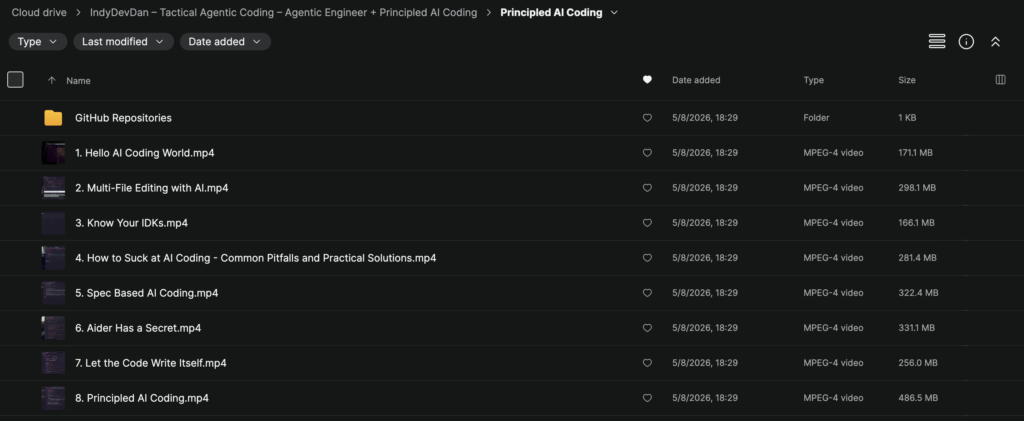
Module 2 – Principles of AI Coding
Learn how to apply structured software engineering principles to AI systems.
Topics include:
- Clean code for AI applications
- Prompt management
- AI pipeline organization
- Structured output handling
- Engineering reliability practices
This section focuses heavily on principled AI development.
Module 3 – Tactical Agent Development
Students learn how to build autonomous AI workflows capable of handling multi-step operations.
Topics include:
- Multi-step AI workflows
- Autonomous reasoning loops
- Workflow orchestration
- AI error handling
- Recovery systems
- Reliability strategies
This module focuses on making AI systems more resilient and scalable.
Module 4 – Building AI Coding Assistants
Learn how to create AI-driven development systems.
Topics include:
- Automated coding agents
- AI debugging workflows
- Code generation systems
- AI-assisted software engineering
- Development automation pipelines
This section is especially valuable for developers building AI-powered productivity tools.
Module 5 – Real-World AI Applications
The final section focuses on practical deployment and operational systems.
Topics include:
- AI developer tools
- Workflow automation
- AI-powered operational systems
- Production deployment
- Real-world implementation strategies
The focus is on practical engineering applications rather than isolated experiments.
Key Features of the Course
Hands-On AI Projects
Students build real AI systems and workflows instead of watching theory-only lessons.
Modern AI Tools & Frameworks
The course uses modern AI engineering frameworks and development ecosystems commonly used by professional AI engineers.
Advanced Prompt Engineering
Learn structured techniques for controlling and guiding AI behavior effectively in engineering workflows.
Production-Level Engineering Practices
The course emphasizes:
- Scalability
- Reliability
- Structured architecture
- Maintainability
- Real-world deployment
Updated for 2025
The curriculum reflects:
- Modern AI tooling
- New agentic frameworks
- Current LLM workflows
- Emerging AI engineering patterns
This keeps the course aligned with the rapidly evolving AI ecosystem.
Who This Course Is For
This program is ideal for:
- Software developers
- AI engineers
- Machine learning practitioners
- Automation engineers
- Startup founders
- AI product builders
- Developers using coding assistants
- Technical professionals interested in agentic systems
It is especially valuable for developers wanting to move beyond simple AI prompting into building full AI-driven systems.
Benefits of Learning Agentic Coding
Agentic engineering represents a major shift in software development.
Learning these skills can help developers:
- Build software faster
- Automate repetitive engineering tasks
- Improve productivity
- Design intelligent systems
- Create scalable AI applications
- Build autonomous workflows
- Stay competitive in modern AI development
As AI adoption continues to grow, agentic engineering is becoming increasingly valuable in the technology industry.
Practical Applications of Agentic Engineering
The knowledge gained from this course can be applied to:
- AI coding assistants
- AI debugging systems
- Intelligent workflow automation
- Research agents
- Data analysis systems
- AI product development
- Operational automation
- Autonomous developer tools
These applications are rapidly becoming part of modern software ecosystems and AI startups.
About IndyDevDan
IndyDevDan is known for teaching practical AI engineering systems, autonomous coding workflows, agent architectures, and modern AI development practices focused on real-world implementation and scalable software engineering.
Final Review
IndyDevDan – Tactical Agentic Coding – Agentic Engineer + Principled AI Coding (Updated 2025) stands out as a highly practical and engineering-focused AI development program. By combining agentic system design, structured software engineering, autonomous workflows, AI-assisted coding, and production-level implementation strategies, the course helps developers build real AI-powered applications capable of solving complex problems in modern software environments.
Conclusion
Artificial intelligence is reshaping software development, and the ability to build intelligent AI agents is quickly becoming one of the most valuable technical skills in the industry. IndyDevDan – Tactical Agentic Coding – Agentic Engineer + Principled AI Coding (Updated 2025) provides developers with a practical framework for building scalable, autonomous, and production-ready AI systems using modern agentic engineering principles and tactical AI coding workflows.





Reviews
There are no reviews yet.