




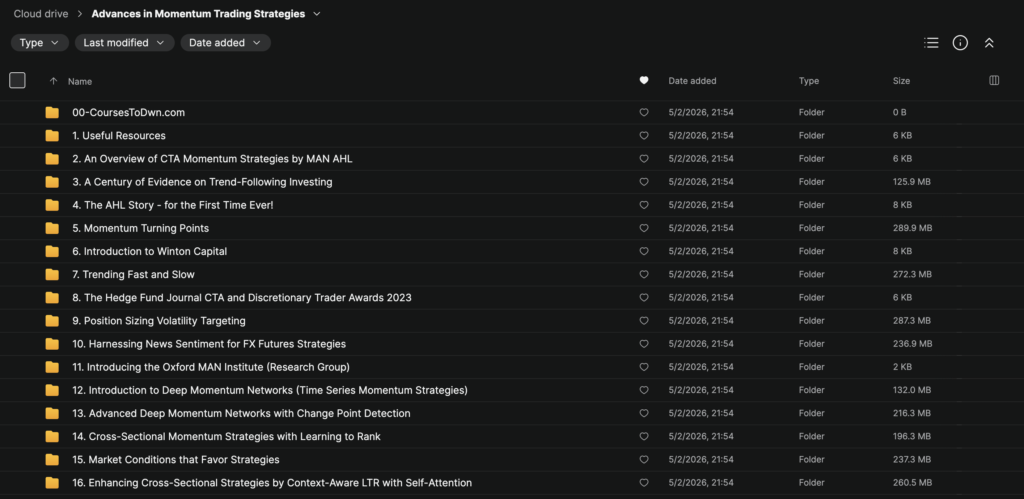
Advances in Momentum Trading Strategies is an advanced quantitative trading and trend-following educational program designed to help traders and investors understand professional momentum investing systems, CTA-style portfolio management, and systematic trend-following strategies used by institutional trading firms and hedge funds.
The program focuses on one major objective:
helping traders build a deeper understanding of momentum-based investing and systematic trend-following strategies capable of adapting across different market conditions.
Instead of relying on emotional decision-making or short-term speculation, this training focuses on evidence-based trading systems driven by quantitative research, portfolio diversification, statistical analysis, and long-term market behavior.
The material appears heavily influenced by institutional CTA (Commodity Trading Advisor) methodologies and professional trend-following frameworks used by firms such as:
- MAN AHL
- Winton Capital
What Is Advances in Momentum Trading Strategies?
Advances in Momentum Trading Strategies is a structured educational resource focused on:
- Momentum investing
- Trend-following systems
- CTA portfolio strategies
- Quantitative trading concepts
- Institutional trading methodologies
- Systematic risk management
- Market trend analysis
- Long-term trading frameworks
The goal is to help traders understand how professional quantitative firms approach markets using rules, data, and systematic execution.
What’s Included Inside The Program
Based on the available structure, the training includes:
Useful Resources
Supplementary materials and reference frameworks for systematic trading research and implementation.
Overview of CTA Momentum Strategies by MAN AHL
This section explores:
- CTA trading models
- Institutional momentum systems
- Diversified trend-following approaches
- Systematic portfolio construction
- Professional risk management frameworks
Students gain insight into how large quantitative firms structure trading systems.
A Century of Evidence on Trend-Following Investing
A research-focused section analyzing:
- Historical market behavior
- Long-term trend-following performance
- Statistical evidence behind momentum strategies
- Risk-adjusted returns
- Multi-decade trend persistence
This helps traders understand the empirical foundations of trend-following systems.
The AHL Story
An overview of how MAN AHL became one of the world’s leading quantitative investment firms using systematic trading methodologies.
Topics may include:
- Quantitative investing evolution
- CTA industry growth
- Institutional portfolio systems
- Algorithmic strategy development
Momentum Turning Points
Focused on:
- Market regime changes
- Trend reversals
- Momentum shifts
- Timing considerations
- Portfolio adaptation systems
This section helps traders better understand how trends evolve and change over time.
Introduction to Winton Capital
An overview of Winton Capital and its systematic trading philosophy.
Topics may include:
- Quantitative research
- Statistical modeling
- Trend-following systems
- Portfolio diversification
- Institutional systematic investing
Trending Fast and Slow
This section explores:
- Different momentum speeds
- Long-term vs short-term trends
- Market behavior cycles
- Adaptive trend systems
- Multi-timeframe momentum strategies
The goal is to help traders understand how different types of trends behave across markets.
CTA & Discretionary Trader Insights
Additional material examining:
- CTA performance
- Discretionary vs systematic trading
- Hedge fund strategies
- Professional portfolio management
- Institutional trading trends
Core Concepts Covered
The program appears heavily focused on:
- Momentum investing
- Quantitative trading
- Trend-following
- CTA portfolio management
- Institutional risk systems
- Diversification
- Statistical market analysis
- Systematic execution
This creates a more research-driven and professional approach to trading.
What Makes Momentum Trading Different
Momentum and trend-following strategies differ from discretionary trading because they focus on:
- Rules-based execution
- Data-driven signals
- Statistical edge
- Long-term trend persistence
- Risk-adjusted portfolio management
- Diversification across markets
These strategies aim to remove emotional bias from trading decisions.
What Makes This Program Different
Many retail trading courses focus heavily on:
- Short-term speculation
- Emotional predictions
- Indicator overload
- High-frequency chart watching
Advances in Momentum Trading Strategies focuses on:
- Quantitative evidence
- Institutional frameworks
- Systematic trading
- Research-backed methodologies
- Diversified trend systems
- Long-term market behavior
This creates a more professional and academically grounded trading perspective.
Key Benefits
By studying this material, traders can:
- Understand institutional momentum systems
- Learn systematic trend-following concepts
- Improve portfolio diversification
- Reduce emotional decision-making
- Analyze historical momentum performance
- Develop evidence-based trading perspectives
- Understand CTA methodologies
- Build more structured trading frameworks
Who This Program Is For
This program is ideal for:
- Quantitative traders
- Systematic traders
- Momentum investors
- CTA strategy enthusiasts
- Hedge fund research learners
- Advanced investors
- Traders interested in institutional methodologies
It is especially valuable for traders wanting to move beyond emotional or discretionary trading approaches.
Why Momentum & Trend-Following Matter
Momentum and trend-following systems remain important because they:
- Have decades of historical evidence
- Can diversify traditional portfolios
- Reduce emotional bias
- Adapt across multiple asset classes
- Focus on long-term statistical behavior
- Are widely used by institutional firms
These methodologies continue to play a major role in professional quantitative investing.
Final Thoughts
Advances in Momentum Trading Strategies provides a research-driven exploration of institutional momentum investing, CTA portfolio systems, and systematic trend-following methodologies used by professional quantitative firms. Through historical analysis, statistical evidence, institutional case studies, and momentum frameworks, the program helps traders and investors better understand how systematic trading strategies can be applied across different market environments using disciplined, evidence-based execution.






Reviews
There are no reviews yet.